

When it comes to French wine classifications like AOC, things can feel complex — but with a few fundamentals, it becomes much clearer. Understanding these systems will help you navigate labels and make more informed wine choices.
New Guide: Strengthen your knowledge of France’s Bordeaux AOCs with Wine Folly’s Bordeaux Region Guide.

What is AOC Wine?
Have you ever been buying wine and noticed the words AOC somewhere on the label?
AOC is short for Appellation d’Origine Contrôlée, and refers to standards set for wines made in France. More broadly, and especially in today’s legal context, this aligns with AOP (Appellation d’Origine Protégée), which is the EU’s term for a Protected Designation of Origin (PDO).
France has hundreds of these AOPs, each defining not just a geographic area but also production rules: permitted grape varieties, vine density, yields, and more. These rules are overseen by INAO, the Institut National de l’Origine et de la Qualité, which protects a wide range of regional food specialties such as Parmigiano-Reggiano in Italy.
Because of recent EU reforms, the framework for AOP (PDO) wines is now governed by Regulation (EU) 2024/1143, which simplified GI (geographical indication) rules and strengthened protections.
Designations of AOC Wine
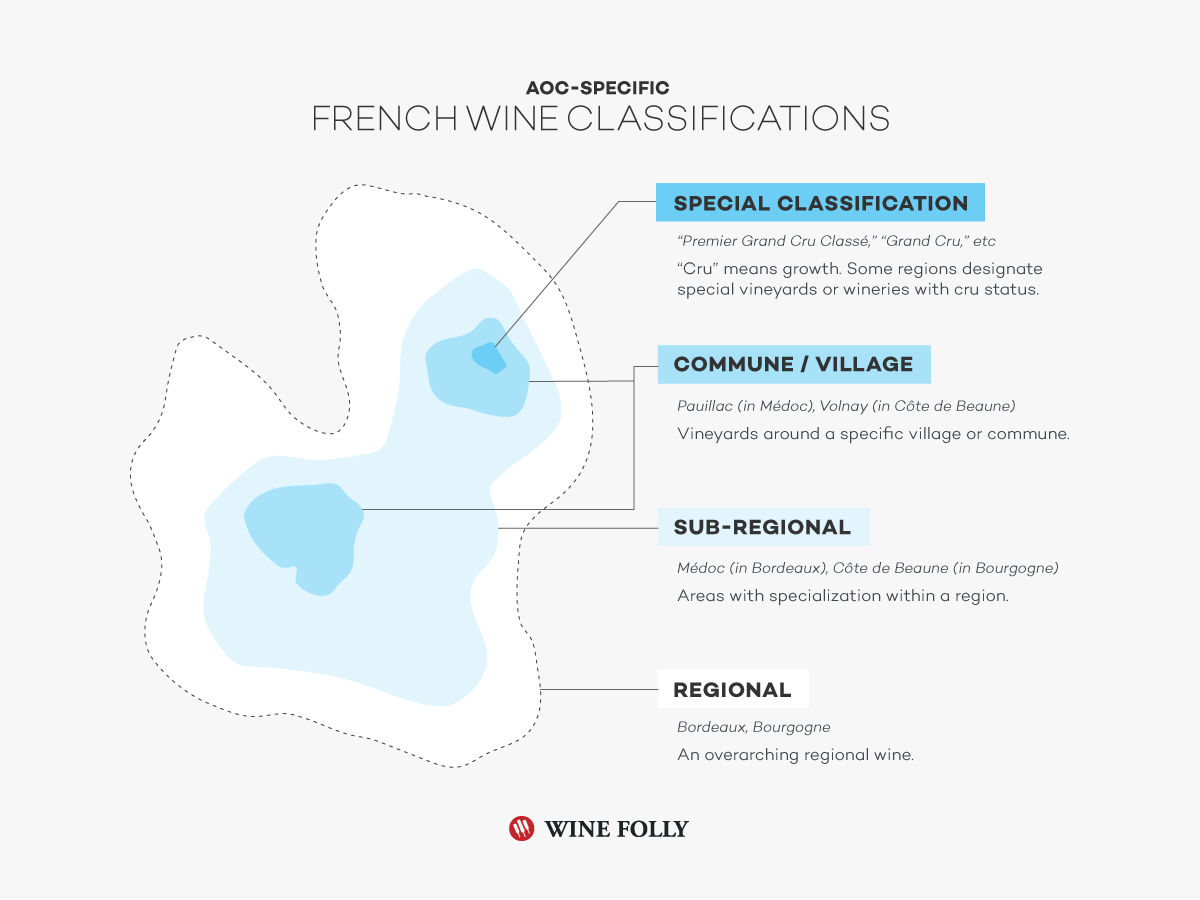
Within the AOC itself, you’ll find several designations that reflect location and quality.
- Regional: Very broad AOPs (e.g., Bordeaux, Burgundy).
- Subregional: More specific areas inside a region (e.g., Médoc in Bordeaux, Chablis in Burgundy).
- Commune/Village: Narrower still — a specific village or small zone (e.g., Pauillac, Côtes d’Auxerre).
- Cru/Premier Cru These indicate recognized quality sites. INAO is increasingly formalizing “cru” designations via Dénomination Géographique Complémentaire (DGC) or lieux-dits rather than relying purely on historic prestige.

Where Did the AOC Come From?
In an effort to control the reputation of wine and other cultural foods, France established the INAO in 1935. Support for the creation of the AOC itself was in large part due to winemaker Baron Pierre Le Roy, leading to the first designated AOC: Châteauneuf-du-Pape.
By 1937, the establishment of the AOC for classic winemaking regions such as Bordeaux, Burgundy, and Champagne took place, setting standards and rules that are still in effect today.
For example, AOC laws ensure that if you buy a bottle of French wine labelled “Champagne,” you’re getting a sparkling wine made in the traditional method from the region of Champagne with Chardonnay, Meunier, and/or Pinot Noir. (And that’s just scratching the surface of standards.)
What’s an IGP?
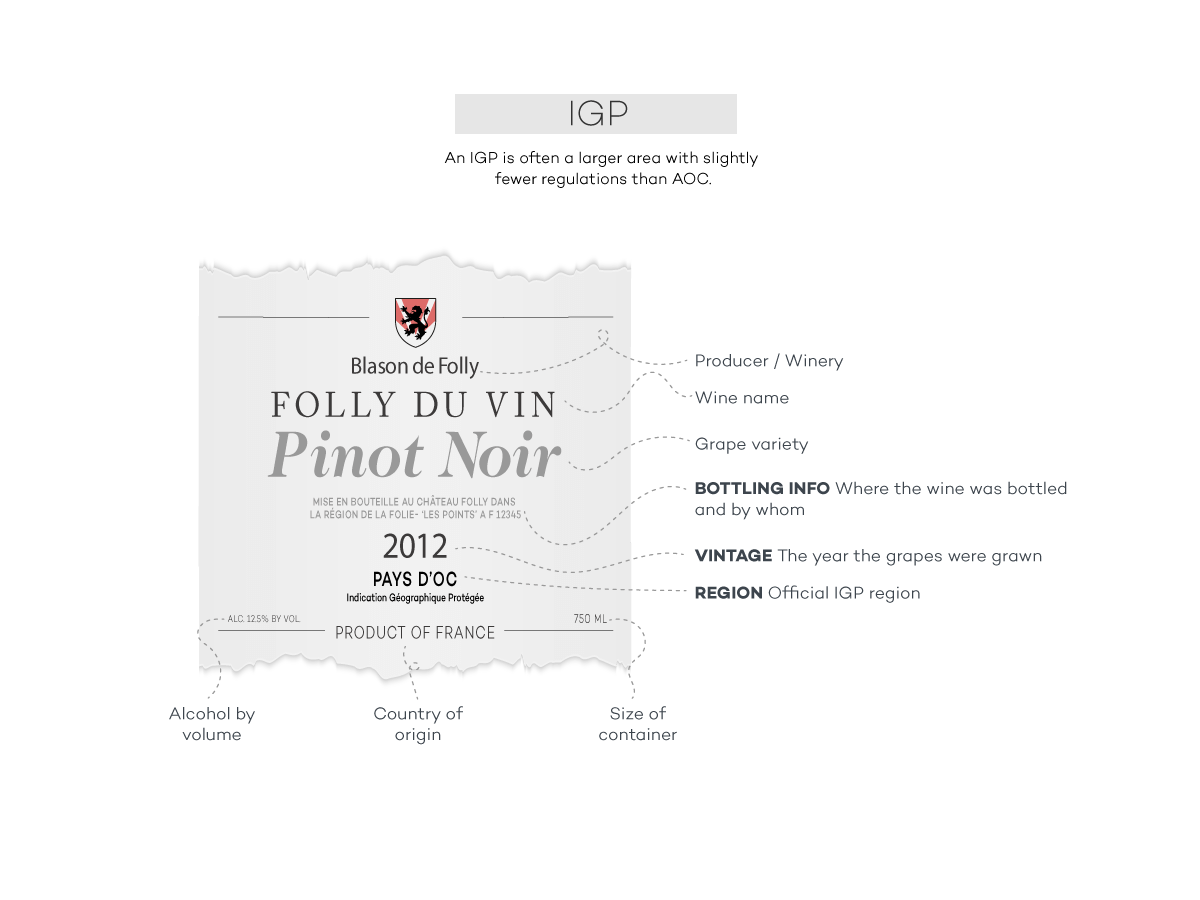
There is another tier of French wine well worth knowing, called IGP wines. This classification name stands for Indication Géographique Protégée and gives producers more leeway in grape varieties and production methods. It is often used for broader regional wines (e.g., Pays d’Oc, Val de Loire).
Critically, in 2025, INAO approved low‑alcohol IGP wines (as low as 6% ABV) for some regions such as Périgord, Comté Tolosan, and Val de Loire.
IGP regional wines have fewer rules, leading to a much greater variation in quality than one would generally see in an AOC wine. In some rare instances, producers choose this classification because their wines fall outside of the ruleset for AOC.
AOC vs IGP: Key Differences
Here’s how AOP and IGP differ in practice today:
- AOP: Tied to very specific places + strict rules. Guarantees origin and certain quality standards.
- IGP: More flexible, often covering larger areas. Rules are looser, especially around grape varieties and alcohol levels.
Just because IGP is more flexible doesn’t mean it’s low quality — it’s more about freedom of style.

What is Vin de France?
At the base of the system is Vin de France, essentially table wine without a protected geographic origin. It’s the least regulated tier: producers don’t have to specify a region, only that the wine is from France. Because of that, “Vin de France” doesn’t guarantee a specific style or terroir.
In rare cases, French wineries choose to “buck the system” and create a totally unique wine that doesn’t follow the rules. These wines get declassified to Vin de France. This exact scenario happened to the 2015 vintage of Graves (Bordeaux) producer, Liber Pater, who used ancient regional grapes not officially allowed in Bordeaux wines. Still, the winery sold them for $5500 a bottle!
Why Wine Classifications Still Matter
Even with these changes, origin-based classifications like AOP remain vital. They:
- Help guarantee geographic provenance.
- Maintain quality through strict regulatory standards.
- Support sustainability and transparency in an evolving wine world.
That said, an AOP label doesn’t automatically mean it’s “better” for you personally — it just means more defined origin + stricter rules. Use it as a guide, not a guarantee of which wine you’ll enjoy most.