

Learn the primary methods of sparkling wine production, including the traditional Champagne method and the tank method (for making Prosecco).
Sparkling wine is among the most technically complex wines in the world — even if it is so easy to drink! Sparkling wines are so complex because of the need for two fermentations: one to make wine and the other to make bubbles.
Since winemakers first began making sparkling wines in the mid-1500s, winemakers have developed several processes, each creating a distinct sparkling wine style. Take a look at the major sparkling wine production methods and which wines are made with each technique.
How Sparkling Wine Is Made
Winemakers use six major methods to produce sparkling wines, each resulting in a different carbonation level and, ultimately, a different style of bubbly. We’ll discuss all the styles, but the most important are the traditional method (for making Champagne and other traditional-method wines) and the tank method (for making Prosecco, etc.).
- Traditional Method
- Tank Method
- Transfer Method
- Ancestral Method
- Continuous Method
- Carbonation

Under Pressure
Sparkling wines have different pressure levels, which affect our perception of their taste. Here are some common terms for sparkling wine in terms of bubble pressure:
- Beady: a wine with <1 additional atmosphere of pressure (14.7 psi) in the bottle. Bubbles appear on the sides of the bottle (or glass) after opening the wine.
- Semi-Sparkling: (including Frizzante, Spritzig, Pétillant, Pearl) a wine with 1–2.5 atmospheres of pressure (14.7–37 psi) that is slightly sparkling.
- Sparkling: (including Mousseux, Crémant, Espumoso, Sekt, Spumante) EU rules state that bubbly wines with 3 or more atmospheres of pressure can have “sparkling” on the label.
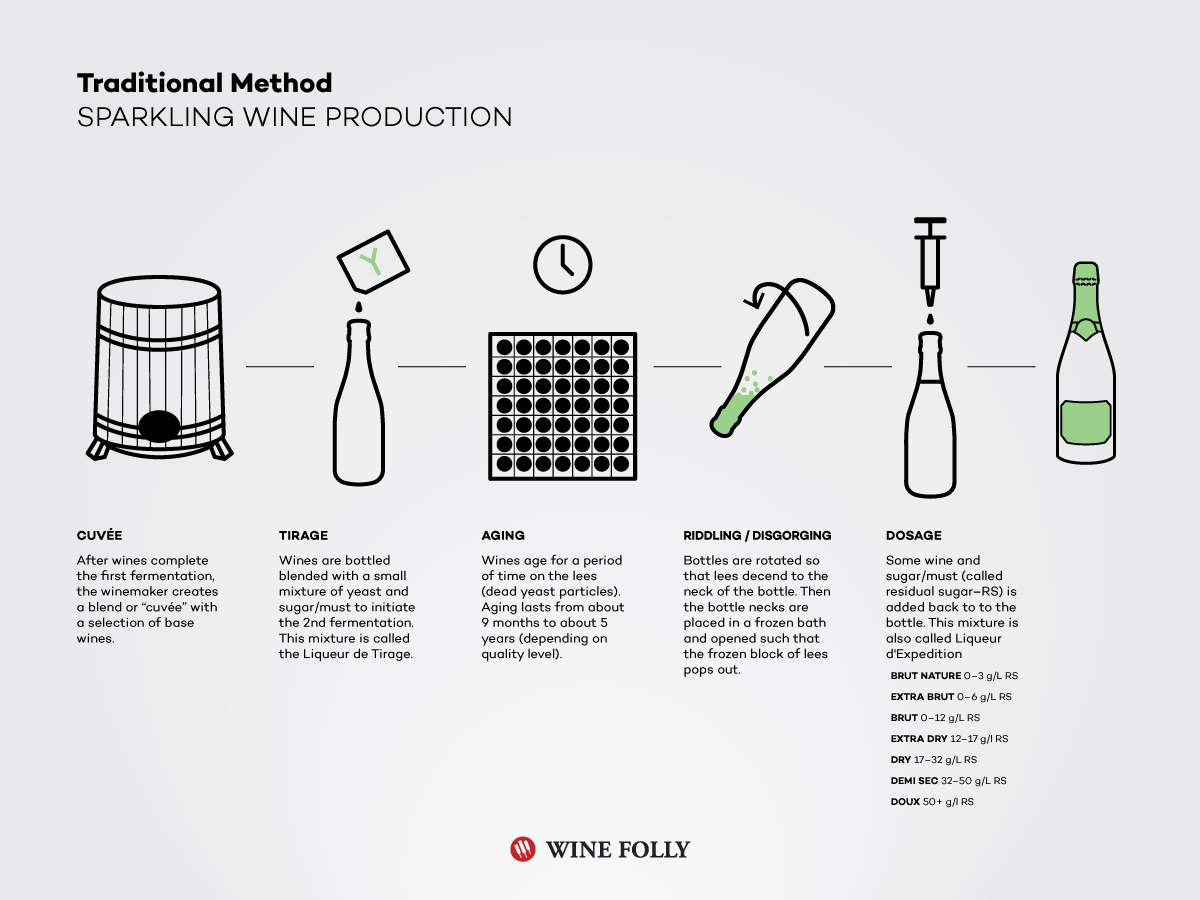
Traditional Method
a.k.a. Méthode Champenoise, méthode traditionnelle, Methode Cap Classique, Metodo Classico, Klassische Flaschengärung
Examples: Cava, Champagne, Crémant, some Sekt, Italian Metodo Classico wines (including Franciacorta and Trento)
Bottle Pressure: 5–7 atmospheres or ~75–99 psi
UNESCO recognized the traditional method of sparkling winemaking in Champagne in 2015. It is arguably the most regarded method for sparkling wine production in terms of quality, but it is also the most costly to produce. The most important facet of the traditional method is that the transformation from a still to a sparkling wine occurs entirely inside the bottle.
- Base Wine or “Cuvée”: after harvest (which is usually early to preserve the grape’s acidity), the juice ferments into a dry wine. The winemaker then takes the various base wines and blends them together into what the French call a “cuvée”, which is the final sparkling wine blend.
- Tirage: Winemakers add yeast and sugars to the cuvée to start the second fermentation. The wines go into bottle and get a crown cap topper.
- Second Fermentation: (inside the bottle) The second fermentation adds about 1.3% more alcohol, and the process creates CO2, which is trapped inside the bottle, thus carbonating the wine. The yeast cells die and undergo autolysis, and remain in the bottle.
- Aging: Wines age on their lees (the autolytic yeast particles) for a period of time for the wine to develop additional flavor, texture, and mouthfeel. Champagne regulations require a minimum of 15 months of aging (36 months for vintage Champagne). Cava requires a minimum of 9 months of aging, while Gran Reserva Cava requires up to 30 months. Many winemakers favor longer lees aging for additional complexity.
- Riddling: Clarification occurs by settling the bottle upside down, allowing the dead yeast cells to collect in the bottle’s neck.
- Disgorging: Removing sediment from bottle. The bottles are placed upside down into freezing liquid, which causes the yeast bits (lees) to freeze in the neck of the bottle. The crown cap is briefly popped off, allowing the frozen chunk of lees to shoot out of the pressurized bottle.
- Dosage: Winemakers add a mixture of wine and sugar (liqueur d’expédition) to fill bottles, and then the bottles are corked, caged, and labeled.
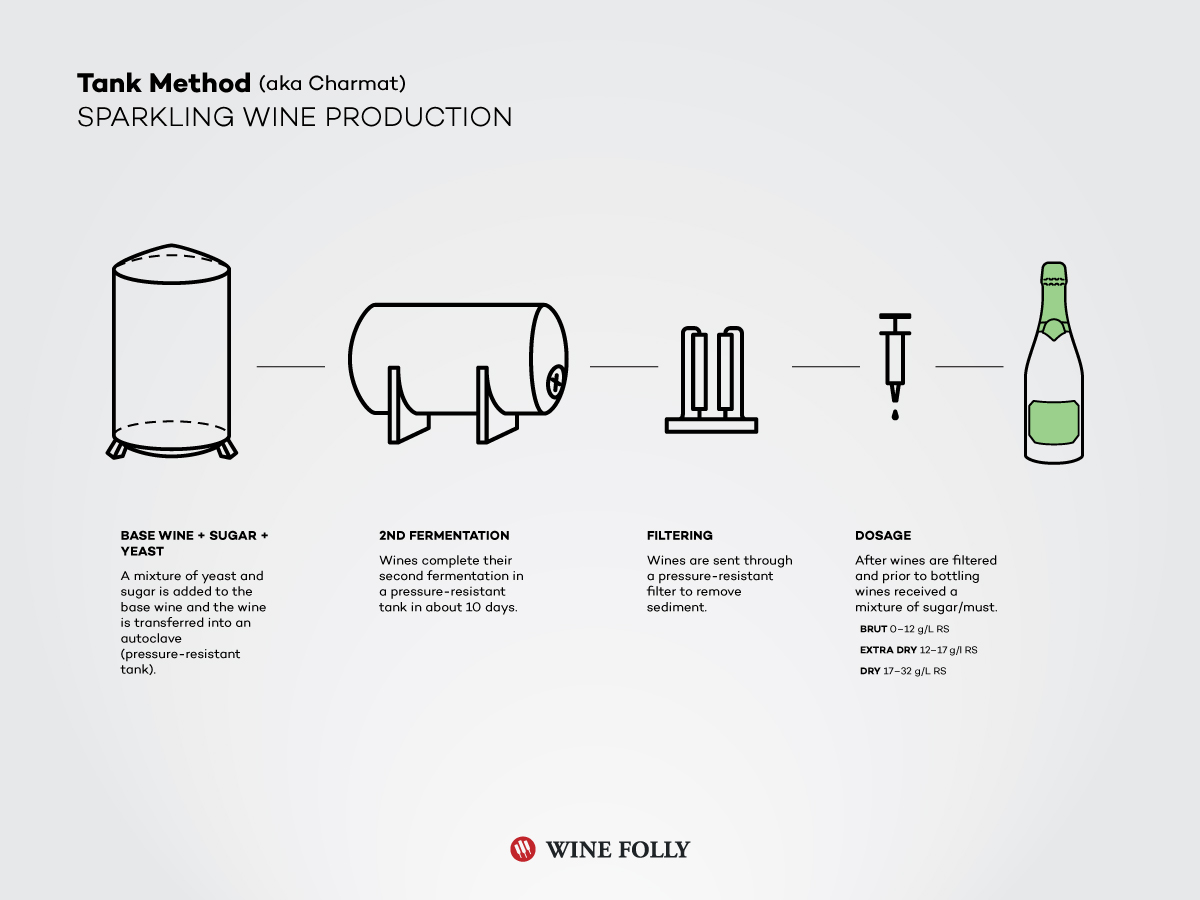
Tank Method
a.k.a. Charmat Method, Metodo Italiano, Cuvée Close, autoclave
Bottle Pressure: 2–4 atmospheres (ATM) 30–60 psi
The tank method emerged during the industrial advances of the early 20th century and is the main process for making Prosecco and Lambrusco wines. The major difference between the tank method and the traditional method is the elimination of the individual bottle as the vessel for converting still wine into sparkling. Instead, winemakers combine the base wines with sugar and yeast (tirage) in a large tank. During the second fermentation, the released CO2 pressurizes the tank. Finally, the wines are filtered, dosed (with liqueur d’expédition) and bottled without aging.
Tank-method sparkling wines have a much fresher character, emphasizing primary fruit and floral aromas with minimal autolytic character. Some may argue that the tank method is not as high-quality as the traditional sparkling wine method. While the process is more affordable (and thus more popular for lower-quality wines), it is still common for fine sparkling winemaking.

Transfer Method
a.k.a. Transversage
Examples: Small format (187 ml) and large format (3L+) Traditional Method sparkling wines
Bottle Pressure: 5–7 atmospheres (ATM) or ~75–99 psi
This method is identical to the Traditional method except that wines need not be riddled and disgorged in the same manner. Instead, the bottles are emptied into a pressurized tank and sent through filters to remove the (lees). Then, the wines are bottled using fillers under pressure. You’ll find this method used most commonly for non-standard bottle sizes (splits or jeroboam and bigger).

Ancestral Method
a.k.a. Méthode Ancestrale, Méthode Rurale, Pétillant Naturel (a.k.a. “Pet-nat”)
Examples: Loire, Jura,
Bottle Pressure: 2–4 atmospheres (ATM) or 30–60 psi
The Ancestral Method technique is one of the earliest forms of sparkling winemaking. This method uses cold temperatures and filtration to pause fermentation midway for months. The wine is put into bottles, and fermentation finishes, trapping the CO2 inside. When the desired CO2 level is reached, the wines are chilled again, riddled, and disgorged. This is just like the traditional method; however, there is no addition of liqueur d’expédition (sugar).
Méthode Diose Ancestrale: This variant of the Ancestral Method empties the wines into a pressurized tank and filters instead of riddling and disgorging.
Carbonation
a.k.a. Gas Injection, Industrial Method
Bottle Pressure: 3 atmospheres (ATM) 45 psi
The carbonation method simply takes a still wine and carbonates it by pressurizing it inside a tank. This method prioritizes speed and cost over complexity. Still, these types of wines can be refreshing in casual settings.
Continuous Method
a.k.a. Russian Method
Bottle Pressure: 4–5 atmospheres (ATM) or 60–75 psi
The Continuous Method is one of the most unconventional. The process gets its name from the continuous addition of yeast into pressurized tanks, thereby increasing the total pressure to 5 atmospheres (or as high as most Champagnes). Wines move into another tank with yeast enrichments (sometimes wood shavings), to which the dead yeast bits attach and float. This gives the wines a similar autolytic character to that of the traditional method. Finally, the wines move into the last set of pressurized tanks where the yeasts and enrichments settle, leaving the wine relatively clear.
All in all, the process takes about a month. Worldwide, there aren’t many producers who use the continuous method, save for a couple of large companies in Germany and Portugal (and Russia).