

Wine alcohol levels span a wide spectrum, from the lightest to the strongest styles in the world. Understanding where a wine falls on the “lightest to the strongest” scale helps explain everything from flavor intensity to how a wine feels in the glass.
The Lightest to the Strongest Wine
At the lightest end, you’ll find delicate, low-alcohol wines shaped by cool climates or early harvests. At the strongest end, fortified wines and ripe warm-climate styles push alcohol much higher, sometimes doubling the strength of lighter bottles. The range is not random; it’s driven by grape sugar, fermentation decisions, and climate, all working together in the background of every bottle.

How Much Wine Should We Be Drinking?
The rule of thumb is that a glass of wine is worth one standard drink. Older guidelines suggested that women get one of these a night, and men get two, but modern recommendations focus more on weekly limits and total intake.
In many guidelines, a standard drink is assumed to be about 12% ABV. So, if you’re drinking a high-alcohol wine like Port (at 20% ABV), the recommended serving size is about half. Yep, sometimes it’s better to get a lower alcohol wine, especially if you love to drink.
You can drink more low-alcohol wine with the same effect as one glass of high-alcohol wine.
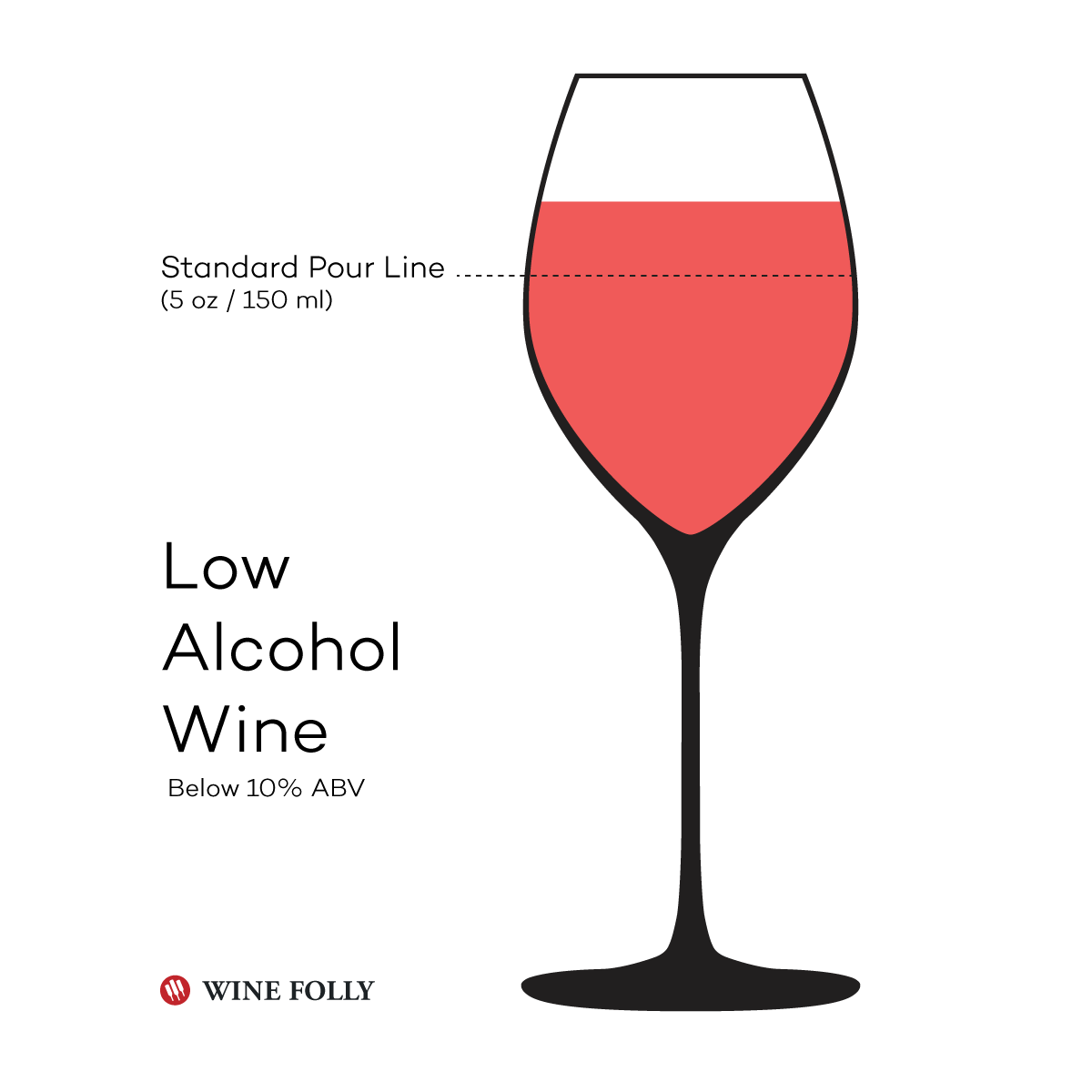
Low Alcohol Wines
Most wines under 10% ABV lean sweet or off-dry, especially in classic styles. Although dry examples exist, depending on style and region. German Kabinett Riesling (8% ABV) and Italian Moscato d’Asti (5.5% ABV) are typical examples of low-alcohol wines.
These wines tend to be sweet because of the residual grape sugar left in the wine after the desired alcohol level is reached during fermentation. The remaining sugar is called residual sugar (RS) and comes from the grapes’ natural sweetness at harvest.
Examples
- Moscato d’Asti 5.5% ABV (lightly sparkling sweet white from Italy)
- Brachetto d’Acqui 6.5% ABV (lightly sparkling sweet red from Italy)
- Kabinett Riesling 8% ABV (light sweet German Riesling)
- Spätlese Riesling 8.5% ABV (rich sweet German Riesling)
- Alsace white wines 9–10% ABV (France)
- Muscadet 9.5% ABV (France)
NOTE: Looking for low alcohol, low calorie dry wines? Read this

Medium-Low Alcohol Wines
Wines with an ABV of 10–11.5% usually come from less-sweet grapes. It’s pretty common to see white wines with medium-low alcohol from cooler climate regions like France, Northern Italy, and Germany.
There are also several sparkling wines in this alcohol-content category because producers pick the grapes a little earlier in the season to ensure the wines stay zesty, with higher acidity to complement the bubbles.
Examples
- Muscadet (France)
- Touraine and Cheverny (Sauvignon Blanc from Loire, France)
- Lambrusco (Italy)
- Soave (Italy)
- Gavi (an Italian wine region that produces white wines with Cortese grapes)
- Pinot Grigio (Italy)
- Grüner Veltliner (Austria)

Medium Alcohol Wines
Many table wines fall between 11.5% and 13.5% ABV.
Examples
- Bordeaux (Cabernet-Merlot blend from France)
- Bourgogne (Pinot Noir or Chardonnay from France)
- Champagne (France)
- Côte du Rhône (France)
- Beaujolais (France)
- Chianti (Italy)
- Dolcetto (Italy)
- Barbera (Italy)
- Nebbiolo (Italy)
- Rosé Wine
- Sauvignon Blanc (California)
- Value Reds (California)
- Red Wines (Chile)
- Riesling (Washington)
- Pinot Gris and Pinot Noir (Oregon)
TIP: The higher the alcohol, the bolder and richer the wine will taste.

Medium-High Alcohol Wines
This is the average range of dry American wines and other warm-climate growing regions, including Argentina, Australia, Spain, and Southern Italy. Regions with warmer climates produce sweeter grapes, which in turn increase the wine’s potential alcohol content.
Examples
- Chardonnay (California and Washington)
- Viognier (California)
- Petite Sirah (California)
- Pinot Noir (California)
- Cabernet Sauvignon and Merlot (California and Washington)
- Zinfandel (California)
- Grenache aka Garnacha (Spain and Australia)
- Shiraz/Syrah (Australia)
- Pinotage (South Africa)
- Malbec (Argentina)
- Barolo (Italy)
- Amarone della Valpolicella (Italy)
- Brunello di Montalcino (Italy)
- Nero d’Avola (Italy)
- Châteauneuf-du-Pape (France)

High Alcohol Wines
High-alcohol wines fall into two categories: fermentation-driven and fortified styles. Fortified wine is when a neutral spirit (usually a distilled grape brandy) is added to wine to increase the alcohol content.
The original purpose of fortifying wine was to preserve its flavor during the Age of Exploration. High-alcohol dessert wines like Port, Marsala, Madeira, and Sherry are commonly fortified, as are aromatized wines (aka Vermouth).
It’s rare to find a natural high-alcohol wine, but they do exist, thanks to advances in yeast selection.
Examples
- Shiraz ~15.5% ABV (Australia)
- Grenache-Syrah-Mourvèdre 15.5% ABV (California and Australia)
- Zinfandel up to 16% ABV (California)
- Late Harvest Dessert Wine 15–17% ABV
- Sherry 15–20% ABV (Spain)
- Port and Tawny Port ~20% ABV (Portugal)
- Banyuls and Maury ~20% ABV (France)
- Madeira ~20% ABV (Portugal)
- Marsala ~20% ABV (Sicily)
- Aromatized wine (vermouth) 20% ABV
- Other fortified wines
TIP: A wine that is described as “hot” means it has high alcohol content.

Have Wines Become More Alcoholic?
Yes.
The reason wine these days has naturally higher alcohol content has a lot to do with science. For example, back in the 1950s, yeast would not survive in alcohol levels too much higher than 13.5% ABV. In fact, it was common to get a “stuck fermentation” where yeasts would die before all the sugar in the grape juice had been converted into alcohol (This is how White Zin was invented!).
Today, however, modern yeast strains tolerate higher alcohol levels than in the past, surviving up to 16.5% ABV. This also might be why we’re seeing more high-alcohol beers than ever before.
Another viable reason is climate change. The riper and sweeter the grape, the higher the alcohol by volume (because yeast converts sugar into alcohol). Of course, this is a little harder to prove because of many variables.
Suffice to say, if it’s over 14% ABV, be careful with your portion size; it catches up with you quickly!