

Cool climate wines are all about tension: higher acidity, fresher fruit, and lower alcohol. The term “cool climate” refers to wine regions known for varieties like Chardonnay, Pinot Noir, and Sauvignon Blanc.

Cool Climate Wines
Some grape varieties struggle to ripen consistently in cooler climates. For example, heat-loving grapes like Grenache and Zinfandel can struggle to ripen consistently in very cool climates. Instead, expect to find more white varieties alongside lighter-bodied, higher-acid, or more aromatic red wines.
These grapes often shine in cooler growing regions:
Red Wines
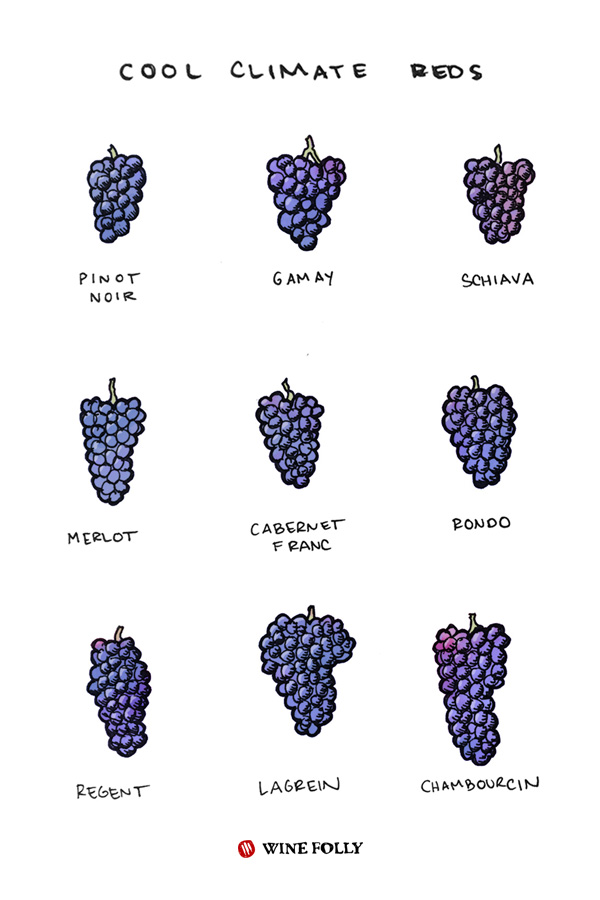
Pinot Noir, Gamay, Schiava, Merlot, Cabernet Franc, Rondo, Regent, Lagrein, Chambourcin
Red wines from cool climates tend to have higher acidity, lower alcohol, lighter bodies, and more savory or spice-driven aromas.

White Wines
Müller-Thurgau, Sauvignon Blanc, Chardonnay, Chasselas, Pinot Gris, Riesling, Madeleine Angevine, Bacchus, Solaris
White wines from cool climates tend to have higher acidity and often show citrus, green orchard fruit, floral aromas, and mineral-driven freshness.
Cool Climate Wine Regions
Different wine varieties prefer different climates. In 2006, climatologist Dr. Gregory V. Jones published influential research linking grape varieties to specific climate ranges. His research defined four major climate categories for winegrowing and the wine varieties best suited to each.
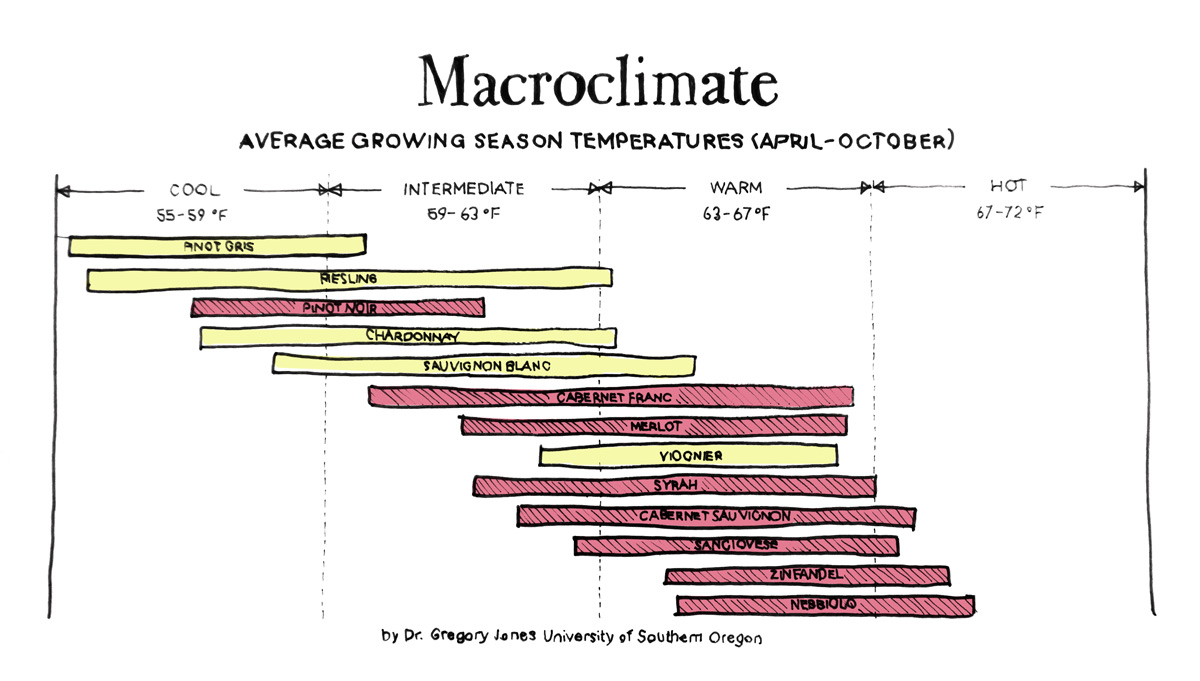
According to Jones, cool-climate wine regions generally experience growing-season temperatures between 55–59 ºF (13–15 ºC), corresponding to roughly 850–1389 growing degree days on the Winkler Index.
So what actually makes a wine region “cool climate”? They generally experience lower growing season temperatures, shorter ripening periods, and slower grape maturation.
A few examples of long-established cooler climate wine growing regions include:
- Marlborough, New Zealand: Famous for razor-sharp Sauvignon Blanc packed with citrus, passion fruit, and grassy aromatics.
- Chablis, France: A region in Burgundy that specializes in a lean, zippy style of Chardonnay that’s known for minerality with bright acidity and restrained oak influence.
- Willamette Valley, Oregon: A region known for its more elegant Pinot Noir and delicate Pinot Gris wines.
- Trentino-Alto Adige, Italy: Valleys in the foothills of the Italian Alps known for alpine-fresh whites, aromatic varieties, and mountain-grown sparkling wines.
- Mosel, Germany: A steep river valley in Germany that produces high-quality Riesling wines.
- Northern Okanagan Valley, Canada: A dry, northern-latitude region in British Columbia specializing in Merlot, Chardonnay, Riesling, and Pinot Gris.
- Champagne, France: A cool region specializing in sparkling wines made with Chardonnay, Pinot Noir, and Pinot Meunier.
Climate Change Is Making New Cool Climate Wine Regions
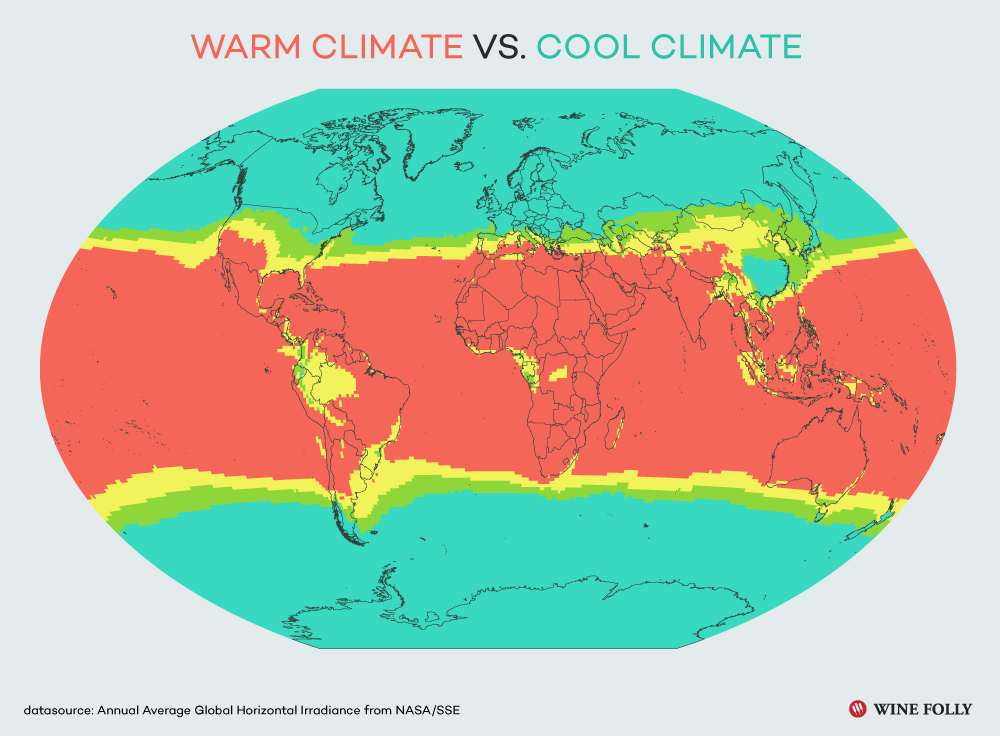
Climate change is reshaping where grapes can ripen successfully, shifting some traditional cool-climate regions warmer while opening new areas to viticulture.
Cool-climate wine regions with recognizable quality growth in the last ~10-15 years:
- England: Chardonnay, Pinot Noir, Bacchus
- Nova Scotia, Canada: Cabernet Franc, Chardonnay
- Michigan, USA: Riesling, Pinot Gris, Chambourcin, and other French hybrids
- Tasmania, Australia: Pinot Noir, Chardonnay, Sauvignon Blanc
Regions increasingly showing potential for quality cool-climate viticulture include:
- Poland: Riesling, Chardonnay, Pinot Noir
- Denmark: Rondo, Müller-Thurgau, Solaris
- Netherlands: Chardonnay, Pinot Gris, Müller-Thurgau
- Sweden: Chardonnay, Vidal, Regent, Solaris
- Puget Sound, Washington: Müller-Thurgau, Madeleine Angevine, Melon