

If you’ve ever wondered how to choose Champagne? I’ll be honest… it isn’t easy.
In the first place, Champagne is not cheap, so you can’t fool around. Additionally, Champagne’s production methods, regional differences, and labeling jargon can make it intimidating for most of us.
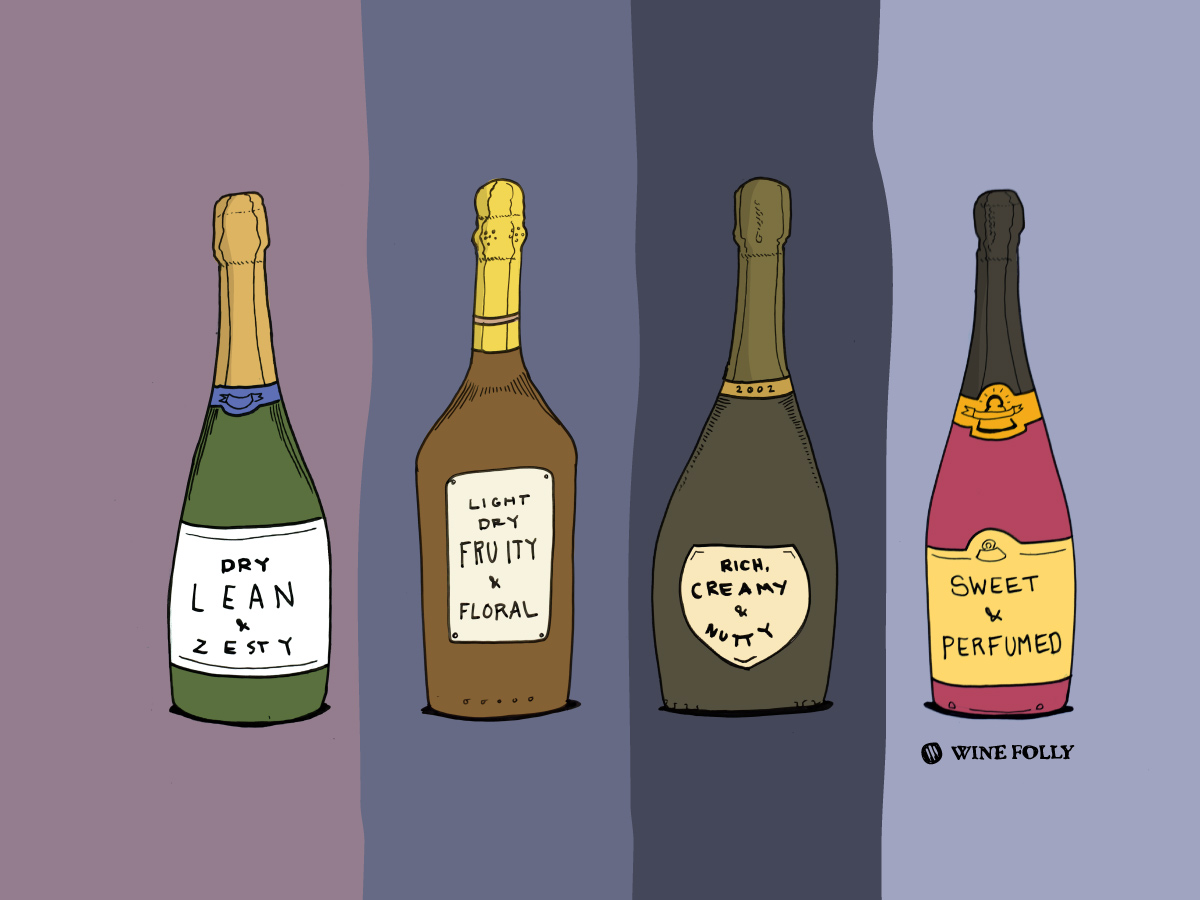
This article helps identify the key things to look for on the label (or when researching) to choose Champagne. So, whether you love a creamy, toasty “shampy” style or prefer a dry, lean style, you’ll find what you’re looking for!
Let’s get one thing out of the way first: not all sparkling wine is Champagne. Champagne refers specifically to sparkling wine made in the Champagne region of France.
Champagne Sweetness Level
All Champagne is labeled with a word to indicate the sweetness level.
Brut Nature, Extra Brut, Brut, Extra-Dry, Dry, and Doux
Champagne producers add a sweetened “dosage” (a mixture of wine and sugar or grape must) that’s added at the end of the second fermentation (the part that makes the bubbles).
Champagne base wines are intensely aciditic, and dosage is used to fine-tune balance. That said, Brut Nature styles show that Champagne can shine even without added sweetness.
So that you know, most Champagne is produced at a Brut level of sweetness.
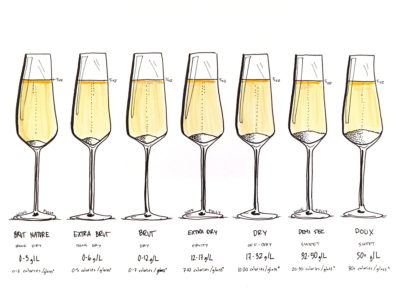
See Complete Sweetness Levels
Learn the exact numbers of dosage (sweetness) levels in Champagne.
Champagne Styles
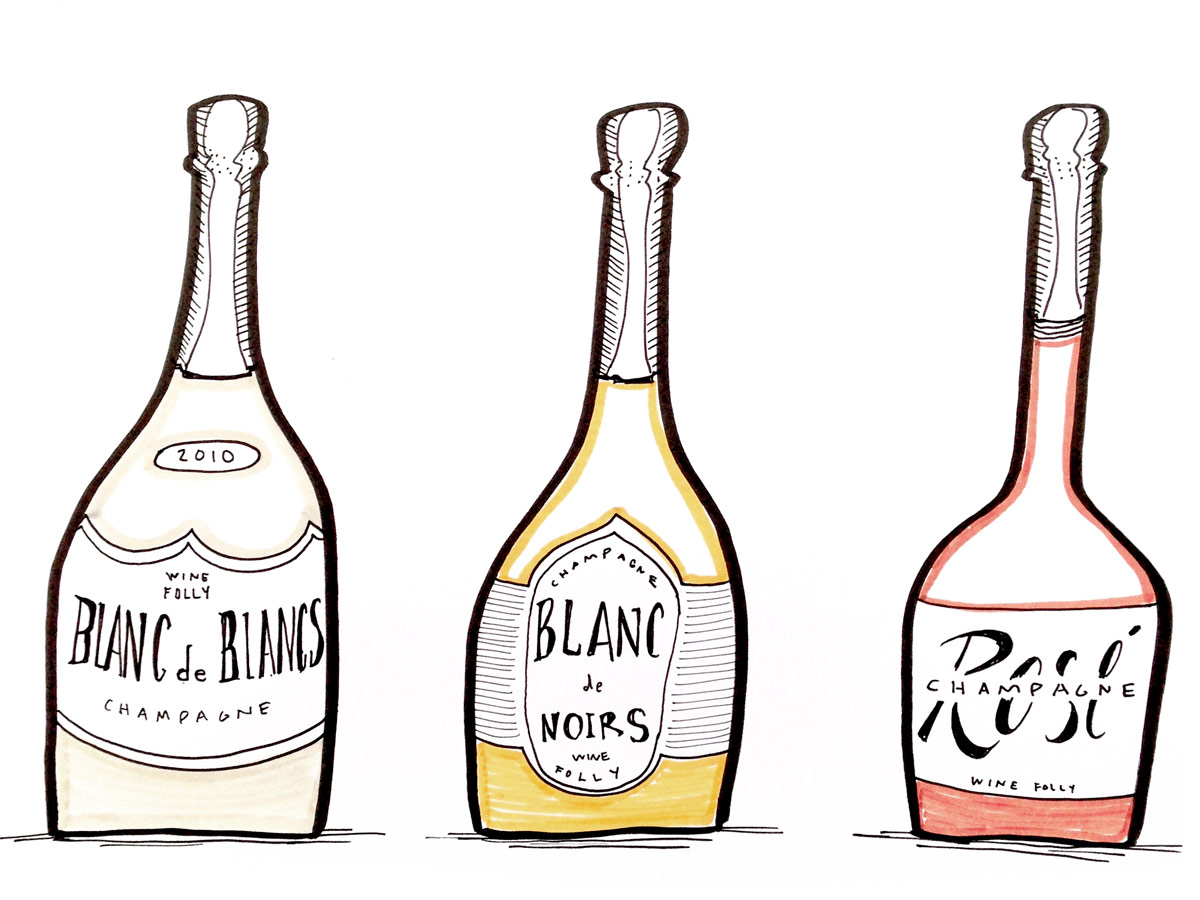
Standard, Blanc de Blancs, Blanc de Noirs, Rosé
There are three primary grapes used to make Champagne: Chardonnay, Pinot Noir, and Pinot Meunier. For those in the know, there are also four much rarer grapes of Champagne: Arbane, Pinot Blanc, Petite Meslier, and Fromenteau (aka Pinot Gris).
How these grapes are used (or not) gives us a clue to the style. If a label doesn’t list a style, the producer typically blends all three grapes.
Blanc de Blancs
(white of whites) This is a blanc de blancs Champagne made from 100% white grapes. In Champagne, this usually means the wine is 100% Chardonnay (although some other white grapes are allowed). Blanc de Blancs typically have more lemon and apple-like fruit flavors.
There are, of course, a few rare exceptions to this rule with a few very rare grapes (in the same region), including Pinot Blanc, Petite Meslier, and Arbane, but for the most part, Blanc de Blancs is 100% Chardonnay.
Blanc de Noirs
(white of blacks) This is a blanc style Champagne made from 100% black grapes.
In Champagne, this means a blend of Pinot Noir and/or Pinot Meunier. Blanc de Noirs typically have more strawberry and white raspberry flavors.
Rosé
The pink style is usually made by blending blanc de Champagne with a teensy bit of red Pinot Noir or Pinot Meunier.
The red wine for Champagne is very different from Pinot Noir you might think of. Its purpose is to provide pure fruit flavors such as strawberry and raspberry in its taste. Wines are tart, with low tannin and very high acidity.
Producers need only a small amount of red wine to create rosé Champagne.
TIP For those in the know, a few producers are making still red wines in Champagne. Look to the Vallée de la Marne!
Champagne Aging
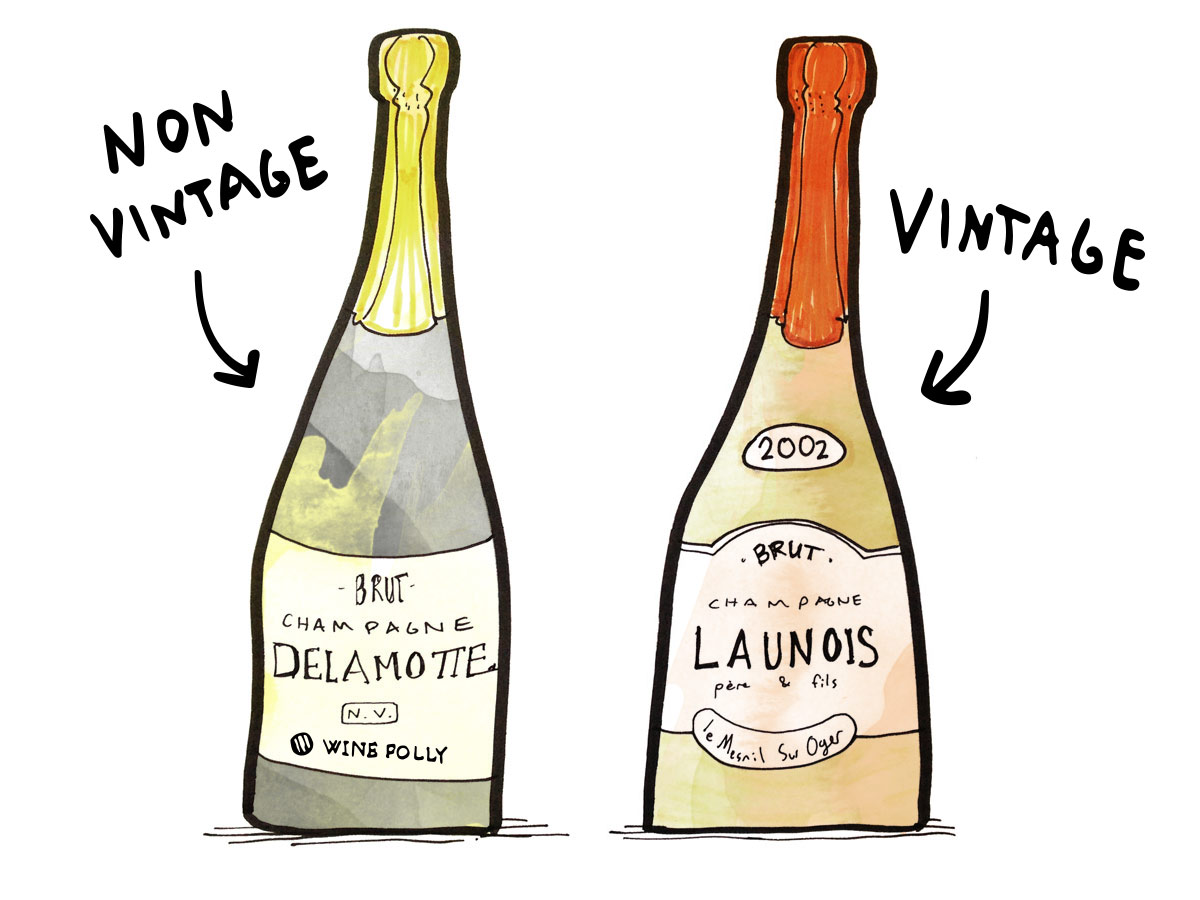
Vintage vs. Non-Vintage Champagne
A key element in how to choose Champagne is understanding how aging influences flavor.
Aging Champagne “sur lie” (on the lees) develops bready, toasty, and nutty aromas – highlights of great Champagne.
The best producers, with the nuttiest wines, age their wines “sur lie” for as long as 5–7 years before release. Even though “sur lie” time is usually not listed, seeing a vintage on the label is a clue.
By the way, if you want to know more about how Champagne is made, check out this other article.
- Non-Vintage: Aged for a minimum of 15 months. Non-vintage (NV) Champagne exists for producers to make a consistent house style each year (regardless of the quality of that year’s harvest). Most NV Champagne is fruitier and less bready than their vintage styles.
- Vintage: Aged for a minimum of 3 years, though many age for 7 to 10 years. On special years when the harvest is particularly good, producers create single-vintage wines. Most opt for a creamy and yeasty style in this aging category.

Regional Classification
Premier Cru, Grand Cru, Autre Cru
Another feature on many bottles of Champagne is the commune name, signifying where the grapes were grown.
There are hundreds of communes, but only 42 have Premier Cru vineyards, and just 17 have Grand Cru vineyards!
Premier Cru and Grand Cru classifications indicate that these vineyards consistently produce outstanding grapes.
Of course, many experts believe that there are several autre crus (other crus), which are equally worthy, but if you have a wine with one of these classifications listed, it’s going to be a safe bet.

Producer Classification
Récoltant Manipulant (RM), Négociant Manipulant (NM), etc.
One way to choose Champagne is to read the producer classification on the label.
So, if you’re one for supporting independent producers, you can do this. Champagne classifies its producers into three types: Maisons (the big guys), Cooperatives (the medium guys), and Vignerons (the little guys).
Types of Producers in Champagne
Maisons
Maisons are the big Champagne houses (Moët, Veuve Clicquot, Perrier, Bollinger, etc.), and they source their grapes from all over Champagne. Here are the label terms often associated with Maisons and other large producers:
- NM “Négociant Manipulant” A producer who purchases grapes or base wines rather than relying almost entirely on their own vineyards. Only producers using at least 95% estate fruit may label their wines as RM (see below under ‘Vignerons’).
- MA “Marque d’Acheteur” aka ‘Buyer’s Own Brand’ is a large retailer or restaurant that buys a finished wine and sells it under their private label. If you’ve ever seen a supermarket have its brand or a fashion brand, this is probably MA.
- ND “Négociant Distributeur” A buyer who labels and distributes Champagne that they neither grew nor produced.
Cooperatives
Cooperatives are in specific villages in Champagne and make a cuvée with multiple growers in the same region (by the way, Nicolas Feuillatte, aka “Nicky Foo,” is the largest cooperative in Champagne!).
- CM “Coopérative Manipulant” A grower’s co-op that pools resources and produces wine under a single brand.
Vignerons
Vignerons are grower-producers or a single-family/person who grows their own grapes in a specific place and makes their own wine.
- RM “Récoltant Manipulant” A grower-producer who uses a minimum of 95% estate fruit. This is classically considered the Champagne grower-producer type, although a Maison can use this classification on a sub-label or brand.
- SR “Société de Récoltants” A union of growers who share resources and collectively market their own brands.
- RC “Récoltant Coopérateur” A grower-producer who has their own Champagne brand made at a co-op facility.
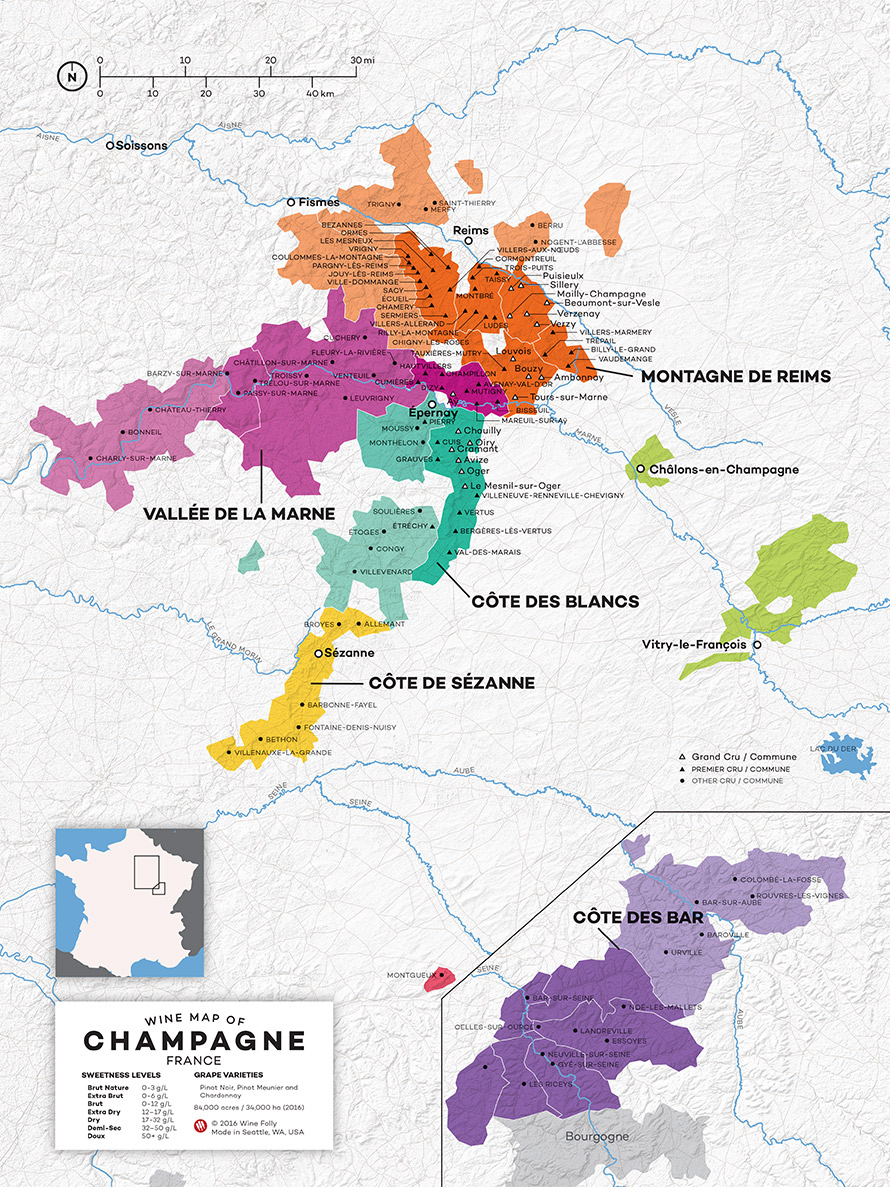
Regional Terroir
Montagne de Reims, Côte des Blancs, Côte des Bar, etc.
The final piece of how to choose Champagne is knowing how each region shapes the wine. There are five main growing regions of Champagne, each known for distinct qualities. Of course, there are many exceptions to these rules, but for the most part, you’ll find Champagnes from the various regions to follow these traits.
Montagne de Reims
A hill south of Reims with many sloping vineyards that face south or southeast, which allow wine grapes to achieve optimal ripeness. The focus here is on Pinot Noir, which leads to a more full-bodied style of Champagne with bigger, richer flavors. The area contains 10 of the 17 Grand Cru vineyards, including Ambonnay, Bouzy, Verzy, Verzenay, and Mailly-Champagne. For example, the prestigious Champagne brand, Krug, uses grapes from the Montagne de Reims.
Vallée de la Marne
The valley along the Marne River is dotted with vineyards. There is just one Grand Cru vineyard here, Aÿ, which is located right outside the city of Épernay. The focus in Vallée de la Marne is on the Pinot Meunier grape, which has an easier time ripening here (because it can be cooler), and produces a rich style of Champagne with more smoky and mushroomy flavors.
Côte des Blancs
This slope faces east and collects the sun. Côte des Blancs is mostly Chardonnay and contains the remaining six Grand Cru vineyard areas of Champagne. This is Blanc de Blancs country, producing some of the finest single-varietal Champagne wines on the market.
Côte de Sézanne
South of the Côte des Blancs is another slope with many vineyards, also dominated by Chardonnay. Despite the potential of this region, you’ll mostly find these wines blended into larger Maisons.
Côte des Bar
This region is far from the rest of Champagne, on the border between Champagne and Burgundy.
Growers in this area primarily plant Pinot Noir and produce a richer style of Champagne, similar to that of Montagne de Reims.
The area lacks a single Grand Cru or Premier Cru vineyard to define its quality. Because of this, many buyers turn to the Côte des Bar for exceptional value.
Last Word: Nothing To Lose
If you are a fan of sparkling wine, Champagne is the benchmark of quality and well worth a taste. Regardless of what you buy, just remember this: the worst-case scenario is you hate it and turn it into a delicious mimosa. We won’t tell anyone. Promise.