

Burgundy can feel complicated. It doesn’t have to be. This simple guide breaks down the region’s five major sub-regions, with maps and essential facts to help you find the right Burgundy for your glass. Learn where to look for Chardonnay, Pinot Noir, and great-value bottles.
A Guide to Burgundy Wine Regions
The French wine region of Burgundy (aka “Bourgogne“) may be small in size, but its influence is enormous in the world of vino. The complexity of Burgundy can cast fear into the heart of even a seasoned wine pro, but fear not — the region need only be as complicated as you want it to be.
Yes, it is home to some of the most expensive wines in the known universe, but there are also tasty and affordable wines.

Just The Facts
The easiest way to wrap your brain around Burgundy is to understand that there are only two grape varieties to remember: Pinot Noir and Chardonnay.
There are others too, of course, like Aligoté, Pinot Gris, Gamay, and Sauvignon Blanc, but Burgundy primarily produces Pinot Noir (Bourgogne Rouge) and Chardonnay (Bourgogne Blanc).
To the Burgundy vigneron (winemaker), the region is not only the original home of these grapes, it is also the terroir (“tear-wah”) that best expresses their character: elegant, aromatic, and complex.
What is Terroir? Terroir is the symbiosis of grapes, soil, climate, vineyard placement, and human touch all rolled into one. Burgundy is all about terroir — it’s not just the taste of rocks!

Where Exactly is Burgundy?
Located in the east-central part of France, Burgundy has five primary wine-growing areas (not including Beaujolais and Châtillonnais):
- Chablis – “shab-lee”
- Côte de Nuits – the night slope
- Côte de Beaune – the slope of Beaune
- Côte Chalonnaise – the Chalon slope
- Mâconnais – the region of Mâcon
A Brief History of Burgundy Wine
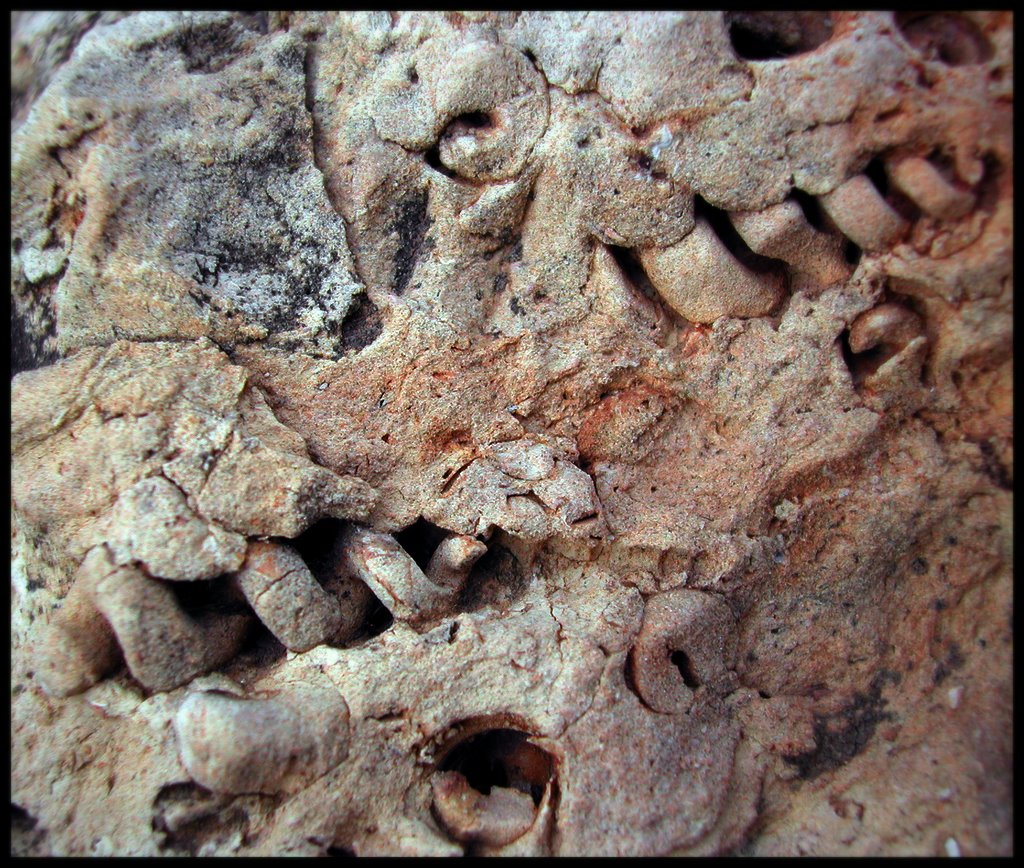
About 200 million years ago, the region was part of a vast, tropical sea. Time transformed the seabed into limestone soils. These soils are the secret behind the zesty minerality that’s the hallmark of Burgundy wines. If you venture into the vineyards, you can find chunks of limestone or marl (limestone mixed with clay) that contain fascinating fossilized sea creatures.
Winemaking goes back to the Romans in the 1st century AD, but it was Catholic monks who really established the vineyards in the Middle Ages. These guys grew the grapes for the church and the aristocratic Dukes of Burgundy. The French Revolution returned the vineyards to the people who, today, pride themselves on their attachment to the land. The personal relationship to the land has inspired growth in organic and biodynamic viticulture and winemaking.
Chablis
Famous for: lean, unoaked Chardonnay.
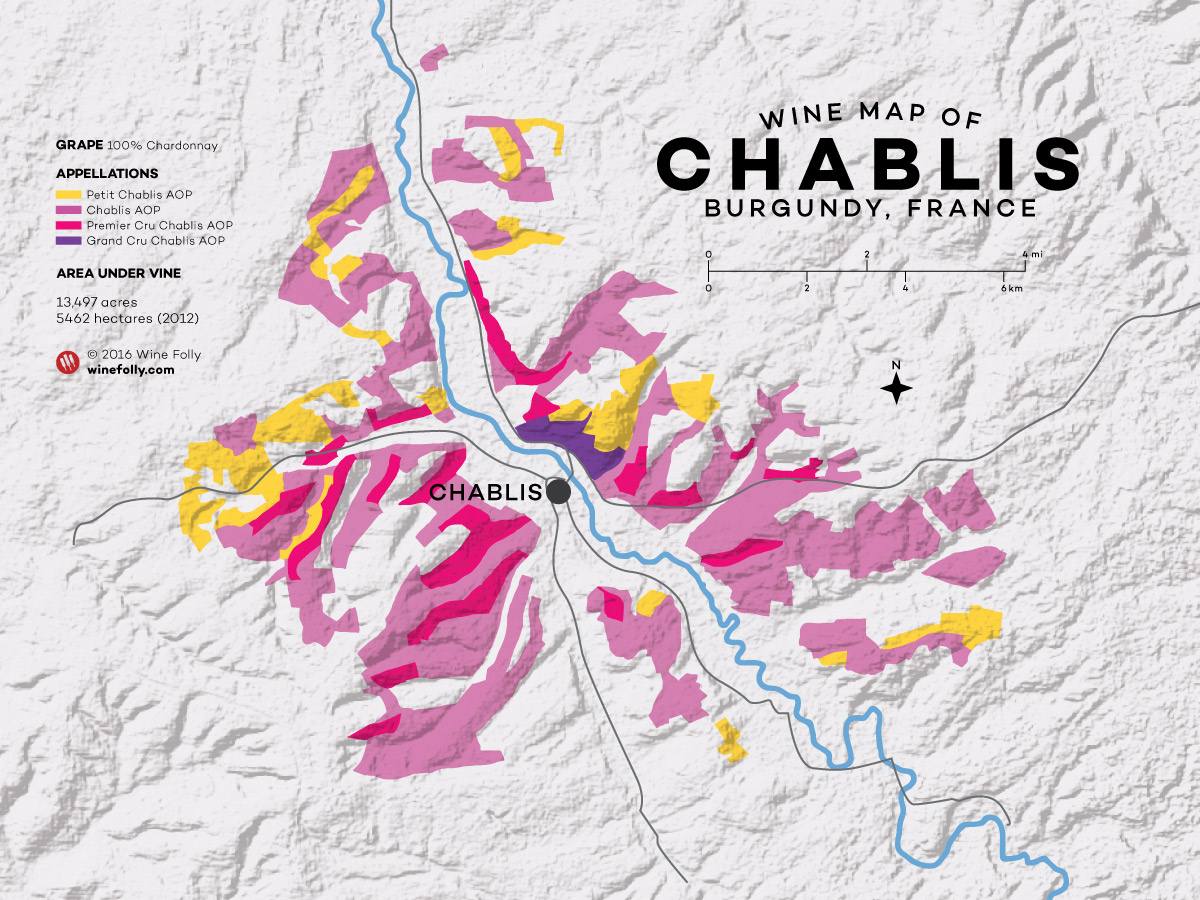
Chablis is the growing region located furthest north and is geographically set apart from the rest of Burgundy. The river Serein (Serene) flows through the area, moderating the climate, and the grapes have been grown here since the Cistercian monks first started the vineyards in the 12th century.
In reality, it’s closer to Champagne, both in terms of location and climate, with harsh cold winters, spring frost, and hot summers. The dominant soil here is Kimmeridgian limestone and marl, a Jurassic geology also found in parts of Champagne. Its pale limestone and marl soils are rich in fossilized oyster shells and reflect the sun’s warmth, sorely needed this far north, which also helps the grapes ripen and gives the wines a purity and crispness.
All the wines are white and made with Chardonnay grapes.

Côte de Nuits
Famous for: Pinot Noir.
The Côte de Nuits (named after walnut trees) is home to 24 Grand Cru vineyards and some of the world’s most expensive vineyard real estate. The area begins just south of Dijon and ends at the village of Corgoloin. 80% of the wines produced here are Pinot Noir, and the remaining 20% are either Chardonnay or Rosé – a specialty of Marsannay.
Grand Cru vineyards form a patchwork on the eastern slopes facing the valley of the Saône River, starting at the village of Gevrey-Chambertin, past Morey-Saint-Denis, and continuing south to Vougeot and Vosne-Romanée. Most are small and can have many owners due to the structure of post-French Revolution inheritance laws. These renowned expressions of Pinot Noir can age for decades – and it might just take that long to save up for them, as prices can easily creep up into thousands of dollars!
But don’t give up! Try Côte de Nuits Village wines from Fixin, Brochon, Premeaux-Prissey, Comblanchien, and Corgoloin. Mostly Pinot Noir, the wines show classic full-bodied Burgundy notes of black currant, cherry, fresh red fruits, and earthy mushroom and spice. Offerings in the Premier Cru category can also be good buys and perfect for special occasions.

Côte de Beaune
Famous for: rich Chardonnay.
The Côte de Beaune, named after the medieval village that is the heart of wine commerce in Burgundy, produces wine quite different from its neighbors to the north.
Here, the valleys are open and rolling, the vineyards have more southeasterly exposure, and Chardonnay plays a more critical role. Seven of the Côte de Beaune’s eight Grand Cru appellations produce white wine; Corton produces both red and white.
Buying Tip:
Look for Villages and Premier Cru wine from:
- Chassagne-Montrachet, Santenay, Meursault, Puligny-Montrachet, Saint-Aubin, Volnay, Pommard, and Beaune
The whites show aromas of soft white flowers, dried grasses, fresh apple and pear, and sometimes a touch of hazelnut.
There are many amazing red wines, too. These wines have flavors of plum, cherry pit, and white tobacco, as well as that Burgundian signature earthy minerality and good acidity.
In The Know
Together, Côte de Nuits and Côte de Beaune are called Côte d’Or.
Côte d’Or means Golden Slope. The Côte de Nuits and Côte de Beaune are historically considered the most important regions in Burgundy.
Côte Chalonnaise
Famous for: value-driven Pinot Noir and sparkling Crémant.
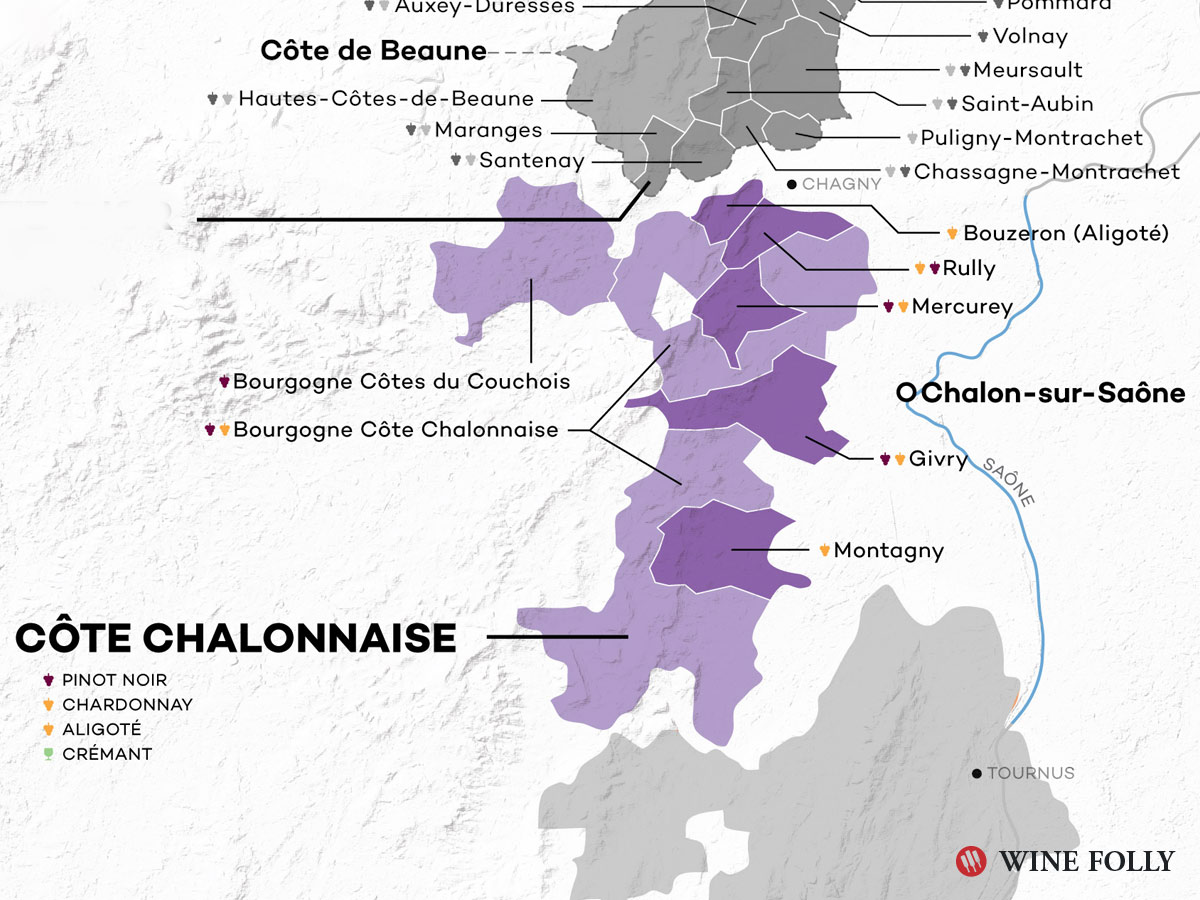
Our next stop in our tour of Burgundy is the Côte Chalonnaise, situated between the towns of Chagny and Saint-Vallerin. Unlike the Côte de Nuits and Côte de Beaune, the Côte Chalonnaise has no Grand Cru vineyards, but it is home to a number of well-regarded Premier Cru sites.
The first village in the northern part of the region is Bouzeron, the only appellation devoted to the other white grape of Burgundy, Aligoté. This is a perfect summer sipper or choice for fish and shellfish. Aligoté is floral, with notes of citrus, flint, and perhaps a touch of honey. Delicious.
Another village that does something a bit different (do we see a pattern emerging?) is Rully, an important center of sparkling Burgundy production since the 19th century. These white and rosé sparklers are made using the traditional method, just as in Champagne.

The villages of Mercurey, Givry, and Montagny lie atop wonderful soils: layers of Jurassic limestone and marl, with topsoils of eroded pebbles and clay.
The area around Givry, in the middle of the Chalonnaise, has over 13 soil types. These different plots give the wines individual character, and the winemakers here know their soils. Some have held the vineyard lands since the 17th century.
The wines from this area are good value. They range from smooth Chardonnays with subtle oak influences and ripe tree fruits to more rustic Pinot Noirs, filled with dried strawberry, cherry, earth and forest influences, and suede-like tannins.

Mâconnais
Famous for: awesome-valued Chardonnay.
The most southerly region and the largest of Burgundy, is the Mâconnais. Once thought of as “ordinary,” this region is somewhat the “rogue” of the family. During hard times, including the Great Depression of the 1930s and the two World Wars, this region felt the brunt of the misfortune.
Many of the local growers sold their grapes to co-operatives to survive. By the 1960s and 1970s, tastes began to change, and wine consumption began to drop. The growers realized they needed to improve their wines to compete. Fruit quality standards were set, and many younger growers, inheriting the family vineyards, decided to make their own wines.
Located between the town of Tournus and Saint-Véran, it lies at the crossroads between Northern and Southern France. The change is striking; as you travel south, even the buildings appear more Mediterranean in color and style, with curved tiles on the rooftops. The climate is decidedly warmer, too; harvest begins a full two weeks earlier here than in Chablis.
In the centre of the region is Viré-Clessé. Although it was declared an appellation in 1999, outstanding wines have been made here for centuries.
The influence of the warmer climate shows up in the well-structured Chardonnays, which have notes of ripe stone fruits, honeysuckle, citrus peel, and wild herbs.
The most famous area in the south: Pouilly-Fuissé. The Pouilly-Fuissé vineyards form a beautiful, open amphitheate. The surrounding villages lie in the valley bottom, cast in the shadow of Roche de Solutré and Roche de Vergisson. Many vineyards border Beaujolais, just over the hills to the south. The soils here are also full of limestone with a bit of granite.
The wines are white and made from Chardonnay, and display soft apple, pineapple, and white peach aromas with wonderful structure and freshness.

Burgundy Wine Classifications
Understanding how wines are classified can help you find better quality Pinot Noir and Chardonnay from Burgundy. There are 84 appellations, or approved wine-growing areas, and these are divided into four levels of quality.
- 1% Grand Cru (e.g. Grands-Échezeaux, Montrachet, etc.) Wines from Burgundy’s top plots (called climats). There are 32 Grand Cru AOCs in the Côte d’Or and one in Chablis. About 60% of the production is dedicated to Pinot Noir.
- 10% Premier Cru (e.g. Vosne-Romanée 1er Cru) Wines from exceptional climats in Burgundy. There are more than 600 Premier Cru Climats in Burgundy.
- 37% Village Wines Wines from a village or commune of Burgundy. There are 44 Village appellations, including Chablis and Nuits-Saint-Georges.
- 52% Regional Wines (e.g. Crémant de Bourgogne, Bourgogne Rouge, etc.) Wines from overarching Bourgogne appellations.
Regional Wines
Regional wines come from broader, geographically defined areas of Burgundy and tend to be fresh, light, and lively, making them terrific sippers or aperitif wines. You will find them labeled “Bourgogne Rouge” (red) or “Bourgogne Blanc” (white). Don’t forget to check out the back label on these wines! Producers can now include the grape variety on the back label, which can be helpful.
If you like sparkling wines, the delightful “Crémant de Bourgogne” is also in this category.
Village Wines
The next step up is the “Village” wines, named after the towns near where the grapes are sourced. These wines are still fresh and fruity, with little to no oak, but they are a tad more complex. Look for names like “Pouilly-Fuissé,” “Santenay,” “Givry,” or “Mercurey.”
Premier Cru Burgundy
“Premier Cru” wines are from special vineyard areas within a village. These bits of vineyard are called “climats” (clee-mats) and produce wines that are a bit more intense than the regular old Village wines!
This might be because of the type of soil, the way the vineyard faces the morning sun, longer aging in oak, or a myriad of other reasons. Premier Cru wines can offer good value compared with Grand Cru bottlings. The label will say “Premier Cru” or “1er Cru.”
Grand Cru Burgundy
And finally, the big daddies of Bourgogne – Grand Cru wines with famous names like Romanée-Conti, La Tâche, Montrachet, etc., and a label that will proudly proclaim the “Grand Cru” status!
Although they account for just over 1% of Burgundy’s annual production, these are the wines people are willing to pay top dollar for. Grand Cru wines are typically among Burgundy’s most concentrated, complex and ageworthy expressions of Pinot Noir and Chardonnay. Burgundy has 33 Grand Cru vineyards — some just inches away from a Premier Cru vineyard.
It’s important to remember that in Burgundy, there are always exceptions to every rule. Here’s one: remember the classifications of wine that apply to Burgundy? Well, they don’t apply in Chablis. The area is famous for zesty Chardonnay and has its own ranking system.
Chablis Classification System
Petit Chablis: Petit Chablis: Produced primarily on the plateaus and upper slopes of the Chablis winegrowing area, often on Portlandian limestone soils. Wines are high in acidity and have lots of light citrus character. These are wonderful when drunk young, so look for recent vintages.
Chablis: These wines are a bit rounder and more minerally, with grapes from the limestone slopes near the village of Chablis. Most of the wines we see on our local shelves are in this category.
Premier Cru Chablis: Only about 15% of the annual production, these wines have nuance and elegance from vineyards with Kimmeridgian limestone marl, giving them a distinctive character. Look for climat names on the label like “Mont de Milieu” (“Mount in the middle”), “Côte de Léchet” (really zesty), or “Fourchaume” (fruity).
Grand Cru Chablis: These vineyards are in a beautiful arc north of the town of Chablis, where the steep slopes face south-southwest. There is technically only one Grand Cru, but there are 7 “climats” inside that Grand Cru, and their names will be on the label: Blanchot, Bougros, Les Clos, Grenouilles, Preuses, Valmur, and Vaudésir. Grand Cru Chablis can taste markedly different from other Chablis because of its distinctive sites, exposure and Kimmeridgian soils, as well as differences in winemaking, including oak aging.